
Gifted Education (AIG)
Advanced Learning & Gifted Education
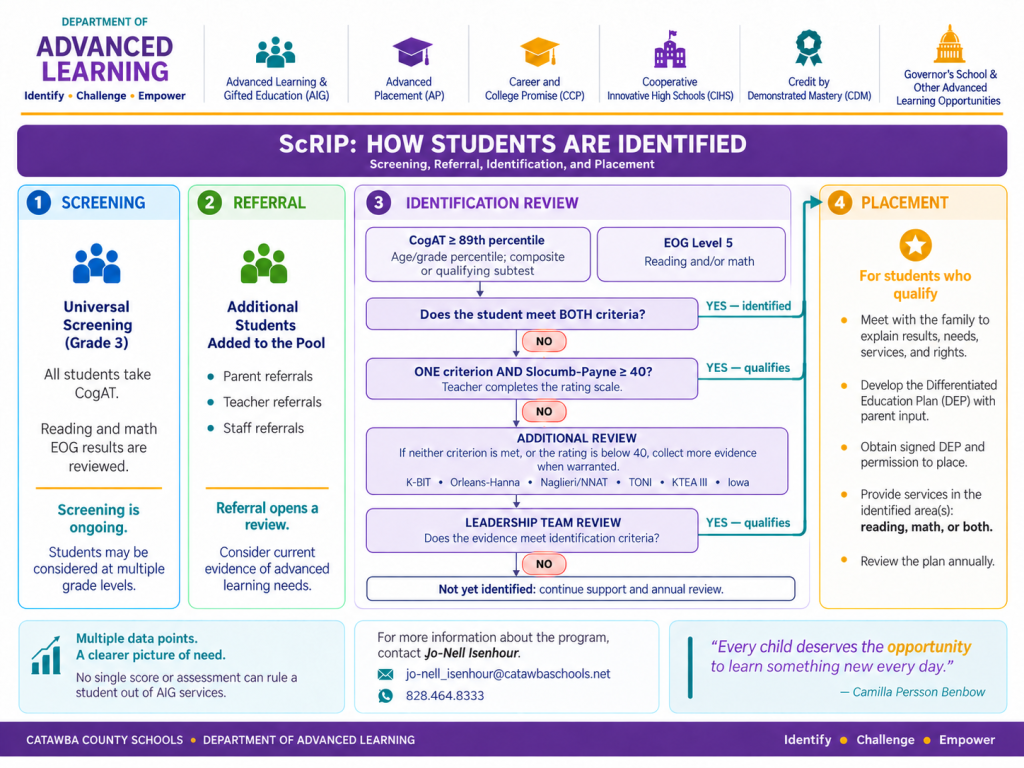
How Students Are Identified for Gifted Services
Explore Advanced Learning
-
AIG stands for Academically or Intellectually Gifted. Our process helps us understand students’ strengths, identify their advanced learning needs, and connect them with appropriate services. Families are partners throughout this process.
1. Screening: Looking for strengths
Screening helps us find students who may need learning beyond the regular classroom curriculum.
All CCS third-grade students take the Cognitive Abilities Test (CogAT), which measures reasoning abilities. Schools also review achievement scores, classroom performance, work samples, and teacher observations.
Students may be considered for AIG services at any grade level, kindergarten through graduation. Being included in the screening pool means a student’s needs will be reviewed; it does not automatically mean the student is identified as gifted.
2. Referral: Bringing a student forward
Parents and guardians, teachers, school staff, and students may refer a student for consideration throughout the school year.
To begin, contact your child’s teacher or the Advanced Learning & Gifted Education office and request the AIG 1 referral form. Families can share examples of their child’s strengths, interests, learning needs, and advanced work.
The school’s AIG Leadership Team reviews the referral and available information to determine whether additional information or assessments are needed.
3. Identification: Understanding learning needs
The AIG Leadership Team reviews a student’s learning profile using multiple sources of information. These may include ability and achievement assessments, the Slocumb-Payne Teacher Inventory, classroom work, observations, and family input.
The team compares this information with district identification criteria to determine eligibility and areas of need. Students may be identified in reading, mathematics, both subjects, or intellectual ability. Specific criteria apply to each identification pathway, including early identification in grades K–3.
Families receive an explanation of the information used and the identification decision. Screening and referral continue throughout a student’s school years, allowing students to be reconsidered as their strengths and needs develop.
4. Placement: Connecting needs with services
Placement connects an identified student with learning experiences that address their advanced learning needs.
School staff meet with families to explain the student’s identification, review permission for placement, and discuss appropriate services. A Differentiated Education Plan (DEP), or an Individualized Differentiated Education Plan (IDEP), documents how those needs will be addressed.
The plan is reviewed annually with families and may be reviewed during the school year when needs change.
Have questions or want to make a referral?
Start with your child’s teacher or contact the Advanced Learning & Gifted Education office at jo-nell_isenhour@catawbaschools.net or 828.464.8333.
-
CCS uses multiple sources of information to understand a student’s advanced learning needs. The identification codes below describe the areas in which a student qualifies for gifted services.
An ability test measures reasoning and learning potential. An achievement test measures knowledge and skills a student has developed. A percentile compares a student’s performance with that of other students; it is not the percentage of questions answered correctly.
Academically Gifted in Reading (AR)
Students meet at least two of these three criteria:
• Ability: A composite or verbal score at or above the 89th percentile on a nationally normed abilities test. Local norms are also used.
• Achievement: Level 5 on the NC Reading End-of-Grade (EOG) test or a qualifying reading/verbal achievement score at or above the 89th percentile on a nationally normed achievement test.
• Teacher inventory: A score of 40 or higher on the Slocumb-Payne Teacher Inventory.Academically Gifted in Mathematics (AM)
Students meet at least two of these three criteria:
• Ability: A composite or quantitative score at or above the 89th percentile on a nationally normed abilities test. Local norms are also used.
• Achievement: Level 5 on the NC Mathematics End-of-Grade (EOG) test or a qualifying mathematics/quantitative achievement score at or above the 89th percentile on a nationally normed achievement test.
• Teacher inventory: A score of 40 or higher on the Slocumb-Payne Teacher Inventory.Academically Gifted in Reading and Mathematics (AG)
Students meet the criteria for both AR and AM described above.
Academically and Intellectually Gifted (AI)
Students meet both of the following criteria:
• Ability: A composite score at or above the 89th percentile on a nationally normed abilities test.
• Achievement: Level 5 on the NC EOG tests in both reading and mathematics, or nationally normed achievement scores at or above the 89th percentile in both subjects.Intellectually Gifted (IG)
Students have a composite score at or above the 98th percentile on a nationally normed abilities test without qualifying achievement scores.
An Individualized Differentiated Education Plan (IDEP) addresses the student’s strengths and needs, including barriers that may keep achievement from reflecting their ability.
Early Identification in Grades K–3
Early identification involves a comprehensive review of a young student’s learning needs. Criteria include scores at or above the 98th percentile on nationally normed aptitude and achievement tests, along with observations, social and emotional considerations, and other information reviewed by the school team and AIG Coordinator.
Families do not need to wait until third-grade screening to raise concerns about advanced learning needs.
What does identification mean for my child?
Identification helps guide services. The student’s DEP or IDEP explains how those needs will be addressed. Families and school staff review the plan together.
-
Gifted services help students grow through learning that matches their strengths and readiness. The goal is meaningful challenge—not simply more work or finishing the same work faster.
How services are delivered
Catawba County Schools uses a consultative model. Classroom teachers work with Advanced Learning & Gifted Education staff to plan instruction that addresses students’ identified learning needs.
Services in reading
Students identified for reading services participate in learning that includes:
• Thematic units organized around essential questions that encourage deep thinking and connections across ideas.
• Shared Inquiry discussions in which students interpret challenging texts, consider different perspectives, and support their thinking with evidence.Teachers may also adjust assignments and learning experiences to provide greater depth and complexity.
Services in mathematics
Students identified for mathematics services have opportunities to demonstrate what they already know. Teachers use this information to reduce or replace practice on material a student has mastered—a process called curriculum compacting.
The time gained allows students to explore mathematics in greater depth or move into new learning. Experiences may include challenging problems, projects, learning contracts, and activities that develop reasoning and creative problem-solving.
Students identified in both areas
Students identified in both reading and mathematics receive services in both subjects. Services are matched to the student’s needs and documented in an education plan.
Your child’s education plan
A Differentiated Education Plan (DEP) describes the services planned for your child. An Individualized Differentiated Education Plan (IDEP) is used when a more individualized plan is needed.
Families and teachers review the plan annually. The team may also meet during the school year to consider changing needs and adjust services.
Family input helps teachers understand a student’s interests, strengths, and learning experiences.
Questions about your child’s services?
Start with your child’s reading or mathematics teacher and the school administration.
-
The early grades are a time to discover strengths, nurture curiosity, and grow as a learner.
Talent development gives young students opportunities to think deeply, solve problems, explore ideas, and express creativity. These experiences also help teachers recognize strengths that may not always appear in everyday classwork.
Learning experiences may include:
• Finding patterns and explaining how things connect.
• Solving puzzles and trying different approaches to a problem.
• Building, designing, and improving a creation.
• Exploring coding through hands-on activities.
• Asking thoughtful questions and explaining ideas.Talent development and formal AIG identification serve different purposes. Early learning experiences help us nurture students’ potential as their strengths emerge.
To learn more about opportunities for your child, start with your child’s classroom teacher.
-
Advanced Language Arts and Advanced Mathematics classes use cluster/ability grouping so students learn alongside peers with similar academic strengths and intellectual needs. Teachers specifically trained to serve gifted learners help students build strong foundations through deeper reading, thoughtful discussions, and challenging mathematical problem-solving.
-
Advanced Language Arts and Advanced Mathematics classes bring students together with academic and intellectual peers for challenging coursework taught by teachers specifically trained to serve gifted learners. Students who meet the criteria may take Math I in eighth grade.
During these years, students also explore their interests and potential careers, making connections between their strengths, what they enjoy learning, and future opportunities.
-
As students grow, advanced learning provides opportunities to explore interests, deepen knowledge, and prepare for goals beyond high school.
Options may include honors courses, Advanced Placement (AP), Career and College Promise (CCP), Cooperative Innovative High Schools (CIHS), and Credit by Demonstrated Mastery (CDM).
These opportunities serve different purposes. Some offer challenging coursework, some provide opportunities to earn college credit, and others allow students to demonstrate mastery or explore an area of special interest.
Each opportunity has its own requirements and application or enrollment process. AIG identification is not a requirement for every advanced learning opportunity, and being identified as AIG does not automatically enroll a student in every option.
Your school counselor can help you explore available courses and programs, understand requirements and deadlines, and plan next steps that fit your child’s strengths and goals.
-
Advanced Placement (AP) courses give high school students the opportunity to study college-level material while still in high school. Students explore subjects in depth and develop skills in critical thinking, problem-solving, research, and communication.
AP courses and AP exams are connected, but they are different. The course provides instruction throughout the semester or school year. The AP exam measures what students have learned.
Students may earn college credit, placement into a higher-level college course, or both based on their AP exam scores. Each college or university determines its own policy, so families should check the policies of colleges they are considering.
When choosing an AP course, consider your child’s interests, preparation, other commitments, and willingness to take on challenging work.
For available courses and enrollment guidance, contact your school counselor. For exam registration, schedules, and testing questions, contact your school’s AP contact.
-
Career and College Promise (CCP) allows eligible high school students to take college courses tuition-free while still in high school.
Students can explore pathways that support their goals:
• College Transfer pathways help students begin earning college credits toward a college degree.
• Career and Technical Education pathways help students build skills toward a certificate, diploma, or workforce credential.These are college courses, so students should be ready for the expectations, independent work, and time commitment involved.
Before enrolling, families should discuss eligibility, course choices, scheduling, transportation, and any costs for books, supplies, or fees with their school counselor. Families should also ask how courses will count toward high school graduation and future college plans.
Interested in CCP? Contact your school counselor to explore available pathways and the steps to apply.
-
Cooperative Innovative High Schools (CIHS), including early colleges, combine high school and college learning through a partnership with a college or university.
Students work toward a high school diploma while also working toward an associate degree, transferable college credit, or a certificate, depending on the school’s program.
This option involves choosing a high school program built around both high school and college coursework. Families should consider the school’s academic focus, learning environment, expectations, schedule, and available activities when deciding whether it is a good fit.
Each school has an application and selection process. Applying does not guarantee admission.
Interested families should contact their school counselor to learn about local options, information sessions, application requirements, and deadlines.
-
Credit by Demonstrated Mastery (CDM) allows a student to earn credit for an eligible high school course by showing a deep understanding of its content without taking the course.
CDM is intended for students who already know the course material and are ready for new learning.
The process includes two phases:
• Phase 1: An examination that measures the student’s knowledge of the course content.
• Phase 2: A project, performance, or other work product that demonstrates the student’s ability to apply that knowledge and those skills.Students must successfully complete both phases to earn credit. AIG identification is not required to participate.
Before applying, families should discuss course eligibility, assessment expectations, deadlines, and how earning credit would affect the student’s future course schedule.
Contact your school counselor to discuss whether CDM may be appropriate for your child and learn about next steps.
-
North Carolina Governor’s School is a summer residential program for gifted and talented high school students. Students live on a college campus while exploring an academic subject or an area of the arts alongside students from across the state.
The program encourages curiosity, creativity, discussion, and new ways of thinking. Students explore ideas beyond the traditional high school curriculum.
Admission is competitive and involves a local nomination process followed by state selection. A nomination is an achievement, but it does not guarantee acceptance.
Application requirements vary by discipline and may include written responses, recommendations, and an audition or other arts submission.
Catawba County Schools pays Governor’s School tuition for CCS students who are accepted into the program.
Interested students should contact their school counselor early to request current application materials and learn about eligibility, local deadlines, and program dates.
-
Paste this into Details:
How do I request an AIG review for my child?
Contact your child’s teacher to request a referral. Families may request a review at any grade level and share information about their child’s strengths, interests, and learning needs.
Can one test score keep my child out of AIG services?
No. No single score or assessment can rule a student out of AIG services. CCS considers multiple sources of information to understand a student’s advanced learning needs and determine whether the student meets identification criteria.
What if my child is not identified now?
Students’ strengths and needs can change over time. Screening continues, and students may be considered again as new information becomes available. Talk with your child’s teacher about appropriate challenges and opportunities now.
Does my child have to be identified as AIG to take advanced classes?
AIG identification is not required for every advanced learning opportunity. Advanced courses and programs have their own placement or eligibility requirements. Your child’s school can help you understand the available options.
Will AIG services mean more work?
The goal is meaningful challenge—not simply more assignments. Services may include deeper discussions, complex problems, opportunities to explore interests, and adjustments to work a student has already mastered.
What is a DEP?
A Differentiated Education Plan (DEP) describes how your child’s identified learning needs will be served. Families and teachers review the plan annually and discuss your child’s strengths, goals, and services.
Who should I contact with questions?
Start with your child’s teacher for classroom questions or school counselor for course planning.